


DatasetMIRACLE#
DatasetMIRACLE is an experimental (semi-synthetic) microphone array data generator that
builds multi-source source cases by convolving synthetic source signals with measured
spatial room impulse responses (SRIRs) from the MIRACLE dataset. The workflow is
analogous to DatasetSynthetic, but the propagation
operator is given by measured SRIRs instead of an analytic free-field model.
Multi-source scenes are realized by superposition of individually convolved source signals. By default, AcouPipe follows the same statistical scene model as in the synthetic generator (Poisson-distributed number of sources, normally distributed source positions, Rayleigh- distributed source strengths).
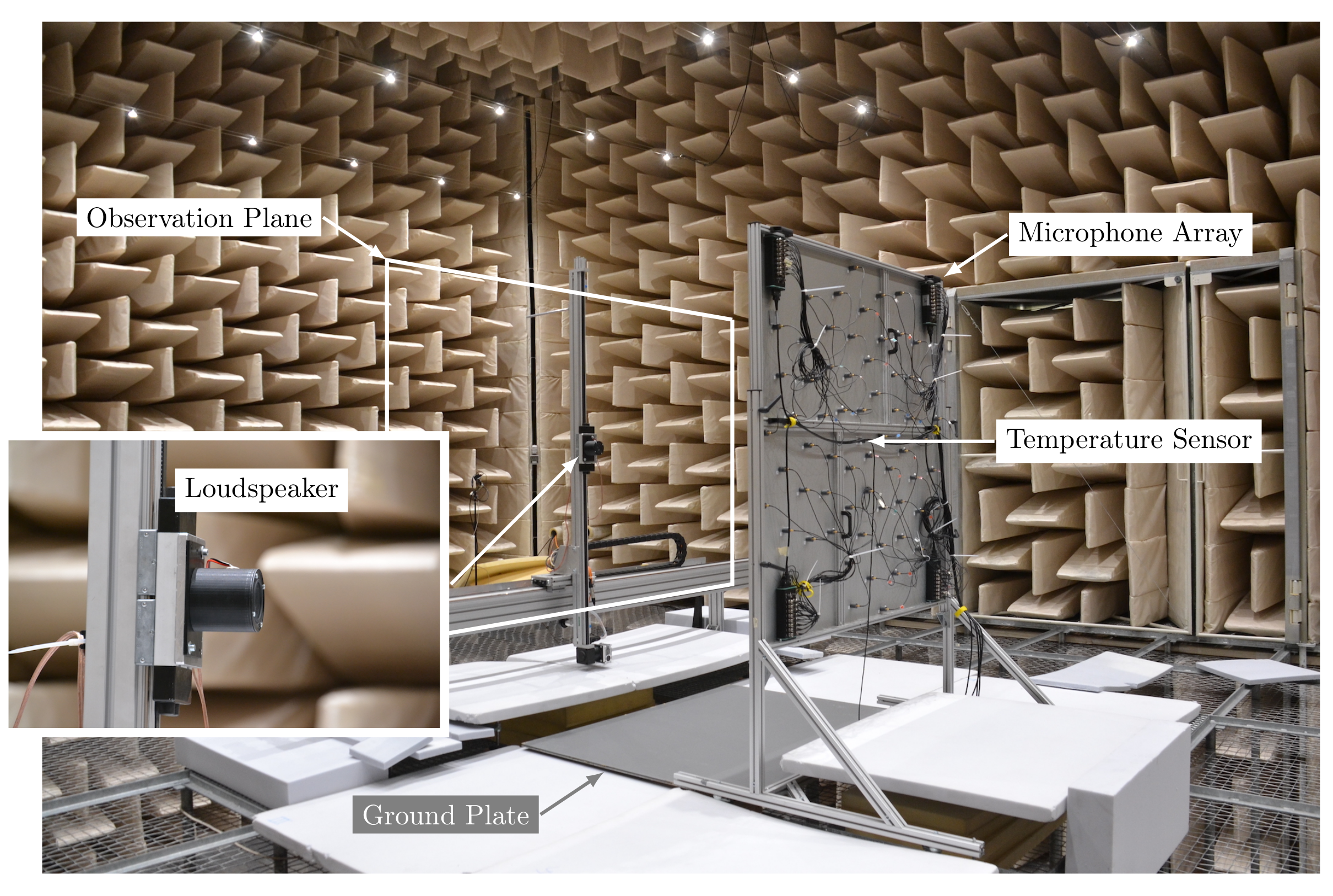
Measurement setup R2 from the MIRACLE dataset (reflective ground plate).#
What the MIRACLE SRIRs represent#
The MIRACLE dataset provides large-scale SRIR measurements acquired with a planar 64-channel array (Vogel spiral, aperture 1.47 m) in the anechoic chamber of TU Berlin. A reflective environment is realized in one scenario by inserting a ground plate between source and array.
In addition to SRIRs, MIRACLE provides metadata relevant for learning and benchmarking, including experimentally obtained loudspeaker directivity information and validated/offset- corrected source positions.
Scenarios#
MIRACLE provides SRIRs for four measurement scenarios. In AcouPipe, the scenario is
selected via the scenario parameter of DatasetMIRACLE.
The table below summarizes the spatial sampling and environmental configuration. Note that
the number of available single-channel SRIRs per scenario is given by
(# sources) × (64 microphones), and the full dataset comprises 856,128 single-channel
impulse responses across all scenarios.
Scenario |
Environment |
c0 |
# sources |
dx = dy |
dz |
Δx = Δy |
Notes |
|---|---|---|---|---|---|---|---|
A1 |
Anechoic |
344.8 m/s |
64 × 64 = 4096 |
146.7 cm |
73.4 cm |
23.3 mm |
short distance |
D1 |
Anechoic |
345.0 m/s |
33 × 33 = 1089 |
16.0 cm |
73.4 cm |
5.0 mm |
dense local grid |
A2 |
Anechoic |
345.3 m/s |
64 × 64 = 4096 |
146.7 cm |
146.7 cm |
23.3 mm |
long distance |
R2 |
Reflective ground plate |
345.4 m/s |
64 × 64 = 4096 |
146.7 cm |
146.7 cm |
23.3 mm |
specular reflection |
Default FFT parameters#
The underlying default FFT parameters are:
Sampling Rate |
fs = 32,000 Hz |
Block size |
256 samples |
Block overlap |
50 % |
Windowing |
von Hann / Hanning |
Note
The FFT settings relate to feature extraction (e.g., CSM / beamforming) and can be overridden in your generation pipeline if required.
Randomized properties#
Several properties of the dataset are randomized for each source case when generating data. This includes the number of sources, their positions, and their strengths. By default, source positions are sampled from the discrete source grid of the selected MIRACLE scenario.
No. of sources |
Poisson distributed (\(\lambda = 3\)) |
Source positions |
Bivariate normal distributed (\(\sigma = 0.1688 d_a\)) |
Source strength (\([{Pa}^2]\) at reference position) |
Rayleigh distributed (\(\sigma_R = 5\)) |
Relative noise variance |
Uniform distributed (\(10^{-6}\), \(0.1\)) |
Example#
The following example script generates sourcemaps for several MIRACLE scenarios and is also used to create the figure below.
 1from pathlib import Path
 2
 3import acoular as ac
 4import matplotlib.pyplot as plt
 5
 6from acoupipe.datasets.experimental import DatasetMIRACLE
 7
 8f = 2000
 9
10fig, axs = plt.subplots(1, 3, figsize=(9, 3), sharey=True, sharex=True)
11fig.suptitle(f"Sourcemap ($f={f}$ Hz)", fontsize=12)
12
13for i, scenario in enumerate([ "A1", "A2", "R2"]):
14
15    dataset = DatasetMIRACLE(scenario=scenario, mode="wishart")
16    data_generator = dataset.generate(
17        features=["sourcemap", "loc", "f"],
18        split="training",
19        size=1,
20        f=[f],
21        num=0,
22    )
23    data_sample = next(data_generator)
24
25    extent = dataset.config.grid.extent
26
27    # sound pressure level
28    Lm = ac.L_p(data_sample["sourcemap"]).T
29    if i == 0:
30        Lm_max = Lm.max()
31        Lm_min = Lm.max() - 20
32
33    axs[i].set_title(f"scenario: {scenario}")
34    im = axs[i].imshow(Lm, vmax=Lm_max, vmin=Lm_min, extent=extent, origin="lower",interpolation="bicubic")
35
36    # plot source locations
37    for loc in data_sample["loc"].T:
38        axs[i].scatter(loc[0], loc[1], s=1)
39    axs[i].set_xlabel("x (m)")
40    axs[i].set_ylabel("y (m)")
41
42fig.colorbar(im, label="Sound Pressure Level (dB)", ax=axs[i])
43fig.tight_layout()
44
The generator yields one sample at a time as a dictionary, including helper fields idx and
seeds to keep data generation reproducible when running in parallel.
Example sourcemaps#

License and access#
MIRACLE is distributed under CC BY-NC-SA 4.0 (non-commercial). Please ensure your intended use complies with the license terms.